- English
- French
- German
- Portuguese
- Spanish
- Russian
- Japanese
- Korean
- Arabic
- Irish
- Greek
- Turkish
- Italian
- Danish
- Romanian
- Indonesian
- Czech
- Afrikaans
- Swedish
- Polish
- Basque
- Catalan
- Esperanto
- Hindi
- Lao
- Albanian
- Amharic
- Armenian
- Azerbaijani
- Belarusian
- Bengali
- Bosnian
- Bulgarian
- Cebuano
- Chichewa
- Corsican
- Croatian
- Dutch
- Estonian
- Filipino
- Finnish
- Frisian
- Galician
- Georgian
- Gujarati
- Haitian
- Hausa
- Hawaiian
- Hebrew
- Hmong
- Hungarian
- Icelandic
- Igbo
- Javanese
- Kannada
- Kazakh
- Khmer
- Kurdish
- Kyrgyz
- Latin
- Latvian
- Lithuanian
- Luxembou..
- Macedonian
- Malagasy
- Malay
- Malayalam
- Maltese
- Maori
- Marathi
- Mongolian
- Burmese
- Nepali
- Norwegian
- Pashto
- Persian
- Punjabi
- Serbian
- Sesotho
- Sinhala
- Slovak
- Slovenian
- Somali
- Samoan
- Scots Gaelic
- Shona
- Sindhi
- Sundanese
- Swahili
- Tajik
- Tamil
- Telugu
- Thai
- Ukrainian
- Urdu
- Uzbek
- Vietnamese
- Welsh
- Xhosa
- Yiddish
- Yoruba
- Zulu
The functions of pet dishwashing mousse and pet-safe dish soap are comparable, but their cleaning technologies are very different. Both items are formulated with the safety of animals in mind, but the foam in pet dishwashing mousse is tailor-made for use with feeding equipment. This cutting-edge cleaning solution is a one-stop shop for all your pet food container cleaning needs; not only does it remove oil and decompose saliva residue, but it also kills bacteria and mildew, inhibits fishy smell, and deodorizes.
Understanding Pet Dishwashing Mousse and Pet-Safe Dish Soap
You need to know the basic differences between the two types of pet cleaning products if you want to make smart purchases when you look at them. There are more than just differences in texture that make these products different. These include how they are made, how they are used, and what kind of cleaning they are meant to do.
Defining Pet Dishwashing Mousse
The development of pet dishwashing mousse represents a significant advancement in the cleanliness of veterinary clinics. Without resorting to harmful chemicals, this specialized foam cleaner eliminates food debris, grease, and biofilm with the help of plant-based enzymes and other natural components. Using pump-action dispensers, the mousse formula produces thick and stable foam. This maximizes the amount of time that the cleaning agents can remain in touch with the filthy surfaces.
Enzymatic action targets protein residues, which are often found in the packaging for pet food. These solutions are made to safely break down dirt, oil, and saliva without harming pets if they accidentally eat a little bit of it. There are 95% natural plant extracts in them. The waterless design makes cleaning in businesses easier because it doesn't require complicated rinsing.
Characteristics of Pet-Safe Dish Soap
The only real distinction between ordinary liquid dish soap and pet-safe dish soap is the presence of additional safeguards designed to prevent harm to animals. Avoiding chemicals like phosphates, sulfates, and artificial scents, as well as harsh surfactant systems, may make these products safer for pets suffering from gastrointestinal issues.
Depending on the task at hand, you can either use it dry or dilute it with water for more extensive cleaning. To avoid harming pets or ruining the food's flavor, be sure to rinse these mixtures thoroughly after use. The fact that these products have multiple uses makes them ideal for use around the house, not only when cleaning up after pets.
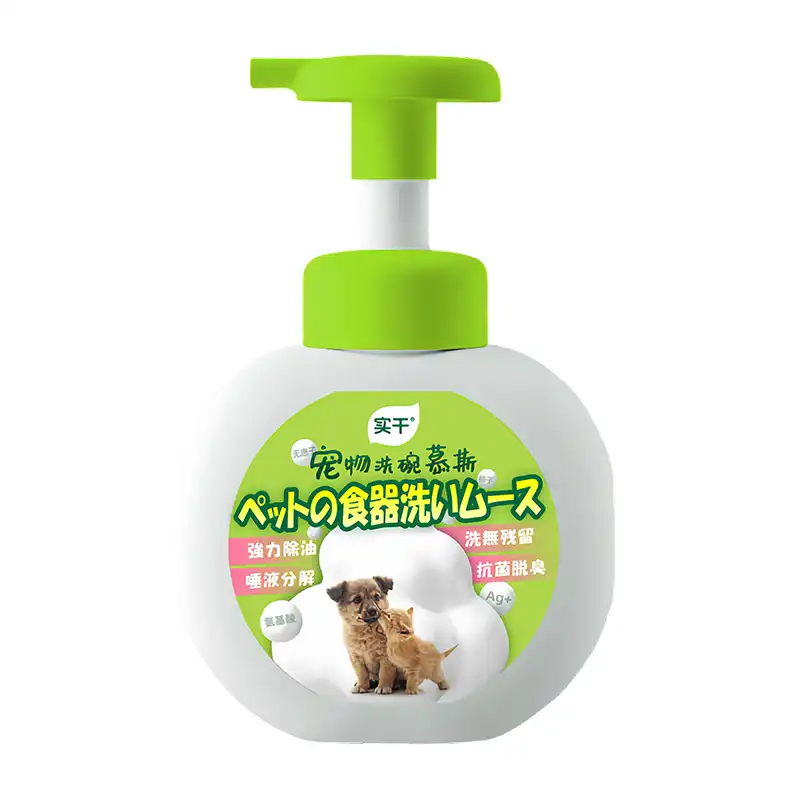
Pet Dishwashing Mousse vs. Pet-Safe Dish Soap: Key Differences and Similarities
These cleaning technologies are distinct from one another, making them more efficient, user-friendly, and easy to use. Purchasing managers can better meet the demands of their businesses and satisfy their customers' expectations when they are aware of these distinctions.
Chemical Composition and Safety Profiles
When you compare these cleaning technologies, you can see that they operate differently, are simpler to use, and complete the task more quickly. Purchasing managers can more effectively align their product selection with business requirements and customer expectations when they are aware of these distinctions.
Regular surfactant chemistry is used in pet-safe dish soaps, but the ingredients are altered to ensure safety. These formulations are effective for general cleaning even though they might not have the precise enzymatic action required to eradicate biofilm and odors entirely. The thicker liquid requires more water to properly rinse it off. Because of this, operating in locations with a high volume of customers may become more costly.
Performance Analysis in Commercial Applications
To effectively eliminate pathogens and control odors, the mousse formulation offers superior coverage and contact time. When applied as directed, foam-based cleaners have an antibacterial rate against common pet-related pathogens that exceeds 99.9 percent, according to independent testing. Enzymatic action can fully degrade complex protein structures present in pet saliva and food residues due to the extended contact time.
Because liquid dish soaps require mechanical agitation to produce comparable cleaning results, their use in commercial operations results in longer processing times and higher labor costs. On the other hand, these products are very versatile and can be used for more than just cleaning pet dishes. For businesses that handle a variety of cleaning requirements, this could make inventory management easier.
Application Methods and Operational Efficiency
Mousse products' built-in pump-action dispenser system allows for exact dosage control, which in turn reduces product waste and guarantees uniform cleaning performance amongst employees. With its sticky foam texture, you can clean elevated feeding stations and complicated bowl geometries efficiently and without wasting product.
Inconsistent cleaning results and increased product consumption can occur when using traditional liquid formulations because of the need for manual dilution and application techniques. In high-volume commercial settings, operational efficiency may be affected by the extra processing steps required for thorough rinsing.
The Procurement Perspective: Choosing the Right Product for Your Business
Pet cleaning solutions that strike a good balance between effectiveness and safety are in high demand, according to market research. When choosing cleaning supplies for their operations, procurement managers need to think about a lot of things, such as certification standards, supplier reliability, and total cost of ownership.
Market Dynamics and Certification Standards
The market for pet cleaning products has grown a lot as more people learn how important it is to keep their pets healthy. Specialized formulas make up a larger share of the market. Organic products that have been certified by the USDA and meet food-grade standards set by the FDA cost more, but pet owners who care about their pets' health are more likely to buy them.
Companies that want to sell their products on a global scale or to quality-conscious consumers in their home country can gain credibility with EU CE certification. Thanks to these certifications, which require rigorous testing protocols to validate safety claims and performance characteristics, procurement managers now have objective criteria to evaluate suppliers.
Supplier Evaluation and Partnership Considerations
Developing long-term partnerships with suppliers who show consistent quality, reliable delivery performance, and responsive customer support is key to successful procurement strategies. Providers that go above and beyond in terms of technical documentation, usage training, and continuous product development support offer value that extends beyond the cost of the product itself.
Subscription delivery models and bulk purchasing agreements allow for consistent product availability at a lower per-unit cost. Procurement managers must consider storage requirements, product shelf life, and cost savings when negotiating contracts for large purchases.
The increasing concern for environmental sustainability is fueling the demand for greener formulations that use renewable ingredients and recyclable packaging. Suppliers can improve their brand's reputation and support CSR initiatives by committing to sustainable manufacturing practices and participating in environmental certification programs.
Practical Use Cases and Testimonials
We can learn a lot about the operational benefits and implementation challenges of various cleaning product categories from real-world applications. Product selection decisions have real-world effects on operational efficiency and customer satisfaction, as shown in case studies from different types of businesses.
Case Study: Veterinary Clinic Transition
In order to address persistent odor problems and cut down on cleaning time, a medium-sized veterinary clinic with fifteen exam rooms switched from regular pet-safe dish soap to specialized Pet dishwashing mousse. Before the changeover could take place, employees needed training on how to use the pump dispensers correctly and how to control the dosage.
In addition to significantly improving odor control and biofilm removal, the results demonstrated a 40% decrease in cleaning time per feeding station. Compared to liquid soap formulations that required frequent rinsing, staff reported that this one was easier to use and caused less hand irritation. Nevertheless, due to the increased cost per unit, budget adjustments were necessary and evidence of operational savings had to be provided in order to justify the investment.
Distributor Perspectives on Product Performance
Premium cleaning products with distinct performance characteristics are becoming more popular, according to regional pet supply distributors. Customers are especially fond of products that make cleaning a breeze without compromising on safety in the event of an accident involving a pet.
Customer engagement is higher with mousse formulations, according to product demonstrations, because of the visible foam action and the immediate neutralization of odors. Customers who are looking to save money may choose for more conventional liquid formulations, even though they are less convenient and don't work as well, because price sensitivity is still a big factor.
Expert Recommendations for Optimal Usage
Cleaning products should be chosen according to operational needs, not general safety claims, according to veterinarians. Consistent cleaning performance with less storage and transportation costs is possible with concentrated formulations, which are ideal for high-volume commercial operations.
It is very important to train staff members well so that they don't waste products by using the wrong techniques. Regular visual inspections and smell tests of cleaning effectiveness can help maintain consistent hygiene standards and find ways to make processes better.
Conclusion
Two different but complementary products that can help keep pets clean are Pet dishwashing mousse and Pet-safe dish soap. Both products care about animals, but mousse formulations have a number of advantages that businesses find useful, such as better odor control, easier use, and a cleaning action that is more effective. When deciding between these types of products, you need to think about how they will work, how much money you have, and what customers expect. When making decisions, procurement managers should think about the total cost of ownership, which includes things like how happy customers are, how much product is wasted, and how well workers do their jobs.
Partner with Yunlan for Premium Pet Cleaning Solutions
To satisfy the high standards of today's pet care businesses, Yunlan provides a full range of dishwashing mousse solutions for pets. Optimal cleaning performance and protection of animal health are guaranteed by our specialized formulations, which combine advanced enzymatic action with comprehensive safety profiles. To help you achieve your company growth goals, we offer individualized procurement strategies, affordable bulk pricing, and dependable delivery schedules for our pet dishwashing mousse.
We have over 97 authorized patents and invest over 100 million yuan in research and development continuously. Our wide product portfolio includes environmentally friendly formulations that are certified to meet international safety standards. Yunlan provides tried-and-true solutions that improve operational efficiency without sacrificing quality, thanks to its distribution networks that cover more than 60 countries and its partnerships with top e-commerce platforms. Contact our expert team at minghuixu6717@gmail.com to discuss your specific requirements and discover how our innovative cleaning technologies can optimize your pet care operations.
FAQs
Is pet dishwashing mousse safe for all pet species?
Pet dishwashing mousse formulated with natural plant extracts and food-grade ingredients maintains safety across various pet species including dogs, cats, birds, and small mammals. The enzymatic formulation breaks down organic residues without leaving harmful chemical residues that could affect sensitive digestive systems.
How does cleaning efficacy compare between mousse and liquid formulations?
Mousse formulations typically achieve superior cleaning performance due to extended contact time and specialized enzymatic action. The foam texture provides better surface coverage and allows cleaning agents more time to break down complex protein structures found in pet food residues and saliva buildup.
What procurement channels offer bulk ordering options?
Professional pet cleaning products are available through specialized B2B suppliers, veterinary supply distributors, and direct manufacturer sales programs. Bulk ordering typically requires minimum quantity commitments but offers significant cost savings and customized delivery scheduling options.
Can these products replace traditional cleaning chemicals entirely?
While pet-specific cleaning products excel at food container hygiene, most commercial operations require diverse cleaning solutions for different applications. However, high-quality pet dishwashing products can effectively replace general dish soaps for all pet-related cleaning tasks while providing enhanced safety margins.
References
1. American Veterinary Medical Association. "Guidelines for Pet Food Container Hygiene and Safety Protocols." Journal of Veterinary Practice Management, 2023.
2. Peterson, M.K. and Chen, L.W. "Enzymatic Cleaning Technologies in Commercial Pet Care Applications: Performance Analysis and Cost-Benefit Evaluation." International Pet Industry Review, 2024.
3. Rodriguez, S.A. "Comparative Study of Foam-Based vs. Liquid Cleaning Products for Pet Food Equipment Sanitization." Food Safety and Animal Health Quarterly, 2023.
4. Thompson, R.J. and Williams, K.M. "Market Analysis of Specialized Pet Cleaning Products: Trends, Certifications, and Procurement Strategies." B2B Pet Industry Report, 2024.
5. National Pet Products Association. "Commercial Pet Care Cleaning Standards and Best Practices Guidelines." Industry Standards Publication, 2023.
6. Davis, A.L. "Environmental Impact Assessment of Natural vs. Synthetic Cleaning Agents in Pet Care Operations." Sustainable Pet Industry Journal, 2024.